
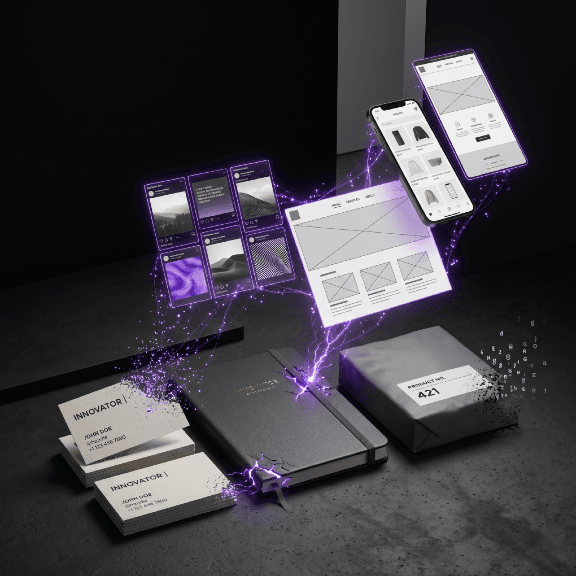
Simple Steps to Align Your Online Branding with Your Offline Presence
You've built something real. Shows, events, merch, industry meetings your offline presence has weight. But then someone Googles you, lands on your socials, and meets a completely different version of you. Different energy. Different visuals. Different voice.
That disconnect? It's costing you more than you think.
This isn't about making everything look prettier. It's about trust. Authority. And the very real business damage that happens when your audience can't figure out who you actually are.
What Brand Misalignment Actually Looks Like
Most artists don't realize they have a brand consistency problem because they're too close to it. Here's what it looks like from the outside:
🎨 Visual chaos across touchpoints Your event flyers are bold and dark, designed by your favorite local printer. But your Instagram grid is light, minimal, and uses three different logo versions. Your merch uses a font you haven't touched in two years. To your audience, these don't feel like chapters of the same story. They feel like different artists.
🎤 Tone that shifts without reason On stage, you're raw, direct, commanding. In interviews, you're thoughtful and sharp. Then someone reads your Instagram captions and it sounds like a completely different person wrote them. Generic, safe, disconnected from the actual human they saw perform last weekend.
📦 Merch that doesn't match the digital world You drop a physical product that doesn't connect to anything you've posted online. No buildup, no visual continuity, no story thread. It sells okay, but it doesn't build anything. It's a transaction, not a brand moment.
These aren't small details. They're signals your audience picks up on, often unconsciously, and they translate directly into how much they trust you as a professional.
Why This Matters More Than Most Artists Think
Here's the reality: your audience meets you in two worlds. Live, physical, in-person on one side. Digital, scrollable, always-on on the other. When those two versions don't match, they don't trust either one.
Trust is the currency. A fan who sees you perform and then can't reconcile that experience with your online presence doesn't become a loyal fan. They stay a casual observer. An industry contact who meets you at a showcase and then can't find a coherent digital footprint quietly moves on.
Perception is reality. You might be incredibly professional behind the scenes. But if your brand looks scattered, people assume the operation is scattered. It's not fair. It's just how humans work.
Inconsistency signals unreadiness. Labels, booking agents, brand partners, they're looking for artists who are built like a business. A fractured brand tells them you're still figuring it out, even when you're not.
The good news: this is a fixable problem. And fixing it doesn't require a rebrand or a big budget. It requires a system.
The Step-by-Step Alignment Process
Step 1: Audit Both Worlds Honestly 🔍
Before you fix anything, you need to see the gap clearly.
Offline audit:
Pull together every physical touchpoint flyers, merch, stage visuals, press kits, business cards
Note the colors, fonts, logos, and imagery being used
Write down three words that describe the vibe of your offline presence
Online audit:
Screenshot your social profiles, website, email newsletters, digital press materials
Do the same: colors, fonts, logos, imagery
Write down three words that describe the vibe of your online presence
Now compare those six words. If they're not the same three words, you've found your problem. Be ruthless here. This audit is only useful if you're honest.
Step 2: Lock Your Core Visual Elements 🔒
Pick them. Commit to them. Use them everywhere.
Primary color palette: 2 to 3 colors max. One dominant, one accent, one neutral.
Typography: One headline font, one body font. That's it.
Logo usage rules: Which version, which size, on which backgrounds. Document it.
Photography style: Are you shooting on digital or film? Moody and dark or clean and bright? Decide and stay there.
This doesn't mean everything looks identical. It means everything looks related. Like a family, not a crowd.
Step 3: Match Your Tone Across Every Platform 🗣️
This one gets overlooked constantly. Visual consistency gets attention, but tone consistency builds relationships.
How you speak on stage, in interviews, in real-life conversations — that's your actual voice. It has personality, rhythm, and character. That same voice needs to show up in your captions, your email subjects, your bio, your press quotes.
Ask yourself: if someone who's never seen you perform reads your Instagram for five minutes, would they recognize the same person from your live show?
If the answer is no, you have tone work to do. Start by writing three sentences that describe how you actually communicate. Use those as a filter for every piece of copy your brand produces.
Step 4: Let Real-World Moments Feed Your Online Strategy 📅
Your events, releases, and appearances shouldn't exist separately from your digital presence. They should be the engine that drives it.
When you have a show coming up, that's not just a date to post. That's:
A content series in the days leading up to it
Behind-the-scenes during
Post-event recaps, reactions, and moments after
When you drop merch, that's not just a product announcement. That's a story about why the design exists, what it connects to, what it means.
This is where online and offline start working together instead of running parallel to each other. The physical moment creates the content. The digital content amplifies the physical moment. They feed each other.
Step 5: Build Brand Guidelines Simple Enough for Your Whole Team 📋
If aligning your brand requires you personally to approve every asset, you'll never scale. And the moment you hand something off to a graphic designer, a social media manager, or a label coordinator, the consistency breaks.
You need a one-page brand guide that covers:
Logo files and usage rules
Color codes (hex, RGB, CMYK)
Font names and where to get them
Tone of voice: 3 to 5 adjectives and what they mean in practice
Examples of on-brand vs off-brand content
One page. Shareable. Simple. This is what separates artists who maintain consistency long-term from those who slip back into chaos every time they bring someone new into the fold.
This Is a System, Not a One-Time Fix
Here's the part most people skip: you can do all of this work and lose it within three months if you don't build it into your workflow.
Brand alignment isn't a project. It's a process.
That means scheduling a quarterly audit. It means having a 10-minute checklist before you approve any new creative. It means asking "does this match who we are?" before you post, before you print, before you send.
The artists and labels that maintain the strongest brand identities aren't necessarily the most creative. They're the most consistent. They've built the habit of alignment into how they operate.
You've got this. It's not complicated, it just takes intention.
Ready to Close the Gap Between Who You Are and How You Show Up?
This is exactly the kind of strategic work we do at ManagerLab. We help established artists, labels, and creators audit their brand, identify where the disconnects are, and build a clear system to close them for good.
If your offline presence is stronger than your online brand or you're not sure which version of you people are actually seeing, let's talk.
Book a discovery call or brand audit with ManagerLab. We'll show you exactly where you stand and what it takes to get aligned.